 Anasayfa
 Canlı Borsa
 Borsa
Borsa Döviz Kurları
 Altın
Altın Hisse Senetleri
 Endeksler
 Kripto Paralar
 Döviz Hesaplama
 Döviz Çevirici
 Kredi Arama

 kriptohavadis
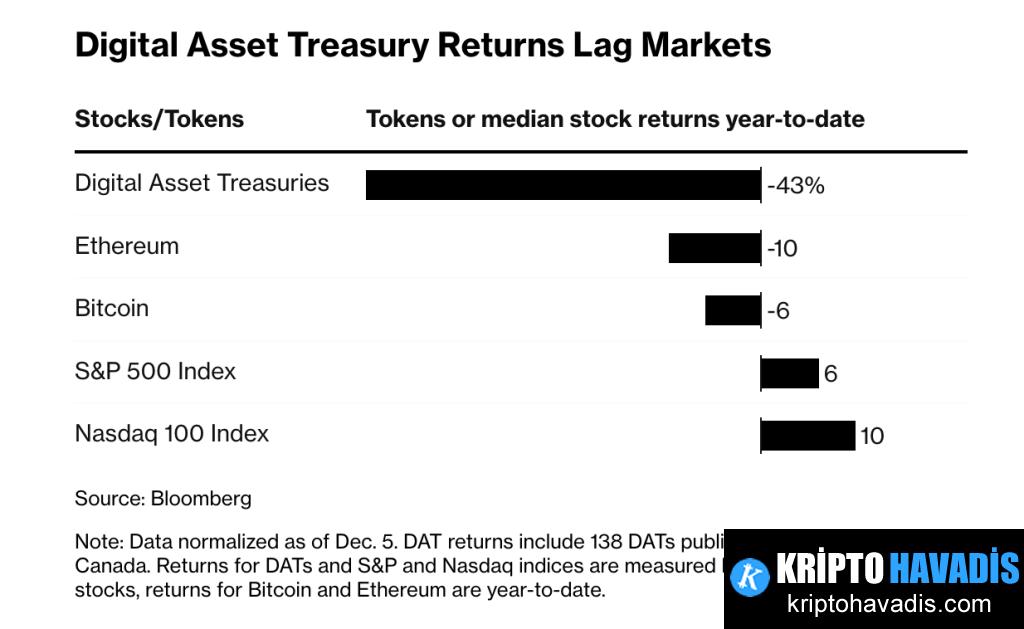
Many companies have imitated Michael Saylor’s Bitcoin strategy by converting their cash into crypto assets; however, this path created vulnerabilities in shares after the initially high returns. According to Bloomberg data, since the beginning of the year, median stock prices have fallen by 43%; while the overall market rose, movements within this group weakened. In the first half of 2025, over 100 companies converted their digital asset wealth and borrowed against their assets to buy cryptocurrencies; however, when the market recovered, the risks of this model became apparent.
Strategy Inc. and its peers attracted investors to convert circulating cash into Bitcoin. In this process, some companies gained high-profile investors; for example, Sharplink Gaming shifted from established gaming operations to a crypto asset portfolio and announced significant purchases of Ethereum. However, shortly afterward, share prices experienced rapid rises followed by declines; their market value lagged behind their crypto reserves. Bloomberg’s data on the digital asset wealth of 138 US and Canada-based entities shows that since the start of the year, the median stock prices have fallen by 43%; Bitcoin had a limited decline. The S&P 500 gained 6%, and the Nasdaq 100 gained 10%. The returns of companies adopting this strategy fell by 60% during the year and have remained above their total gains since August 2020 due to Bitcoin acquisitions.
“Investors now see that the returns from these assets are simply from holding cash,” said Fedor Shabalin, an analyst at B. Riley Securities, in an interview with Bloomberg, pointing out that this situation in a way disconnects stocks from real income flows.
Structural Problems and Debt Loads
Companies faced a significant imbalance in the debt structure used for crypto purchases. Strategy and similar companies issued hundreds of millions of dollars in convertible bonds and preferred shares, directing funds into illiquid crypto assets. These debts require regular payments for uncollateralized assets, but these assets do not generate income. Strategy has an annual fixed obligation of approximately 750–800 million dollars. Some companies, avoiding Bitcoin, have increased their losses by shifting to more volatile cryptocurrencies. Examples like Alt5 Sigma aimed to cover recent dividend payments by creating dollar-based reserves; during this process, value was lost.
Leaders have raised 1.44 billion dollars in reserves through stock sales to mitigate financing issues; this was planned as a resource to cover dividend payments for 21 months.

Saylor’s Statements Regarding Bitcoin Sales
The current breaking point in the industry relates to how companies finance their crypto acquisitions. Phong Le, CEO of Strategy, stated that they can sell Bitcoin as long as the market value remains above that of crypto assets; this caused a major shock in the sector. While Saylor continues to pursue the vision of “storing money in Bitcoin instead of wasting it on deposit,” he indicated that if the market value drops below Bitcoin’s net asset value, they might sell their shares. These remarks increased concerns that market pressure could force sales, lowering prices.
Strategy’s monthly accumulation of Bitcoin has decreased from about 134,000 BTC at the 2024 peak to currently around 9,100 BTC; only 135 BTC were added in December. The company currently holds approximately 650,000 BTC, representing more than 3% of Bitcoin’s maximum supply. Market participants believe that leveraged traders using borrowed money might face margin calls, which could create selling pressure across the markets. The company has created a reserve fund of $1.4 billion to meet near-term dividend payments, but its shares have fallen roughly 38% this year.